Euprepiosaurus
Varanus prasinus (SCHLEGEL 1839)
Green Tree Monitor
  Varanus prasinus is a member of the subgenera Euprepiosaurus.
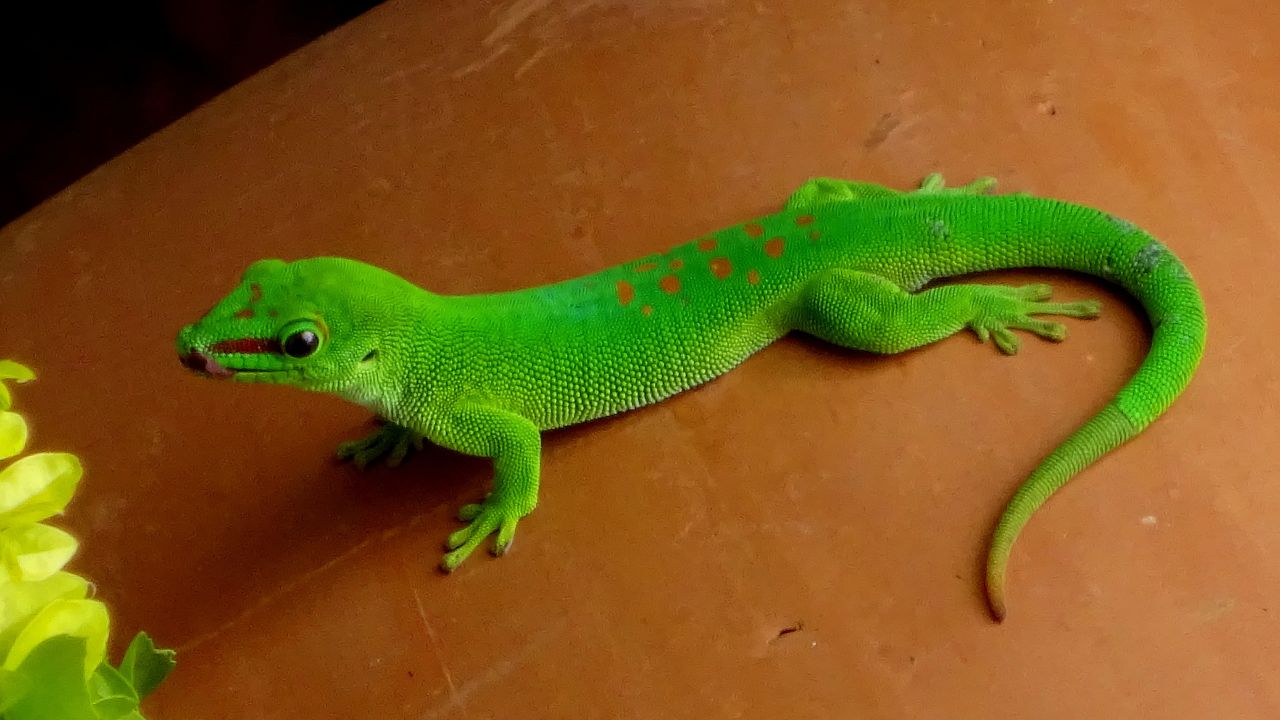
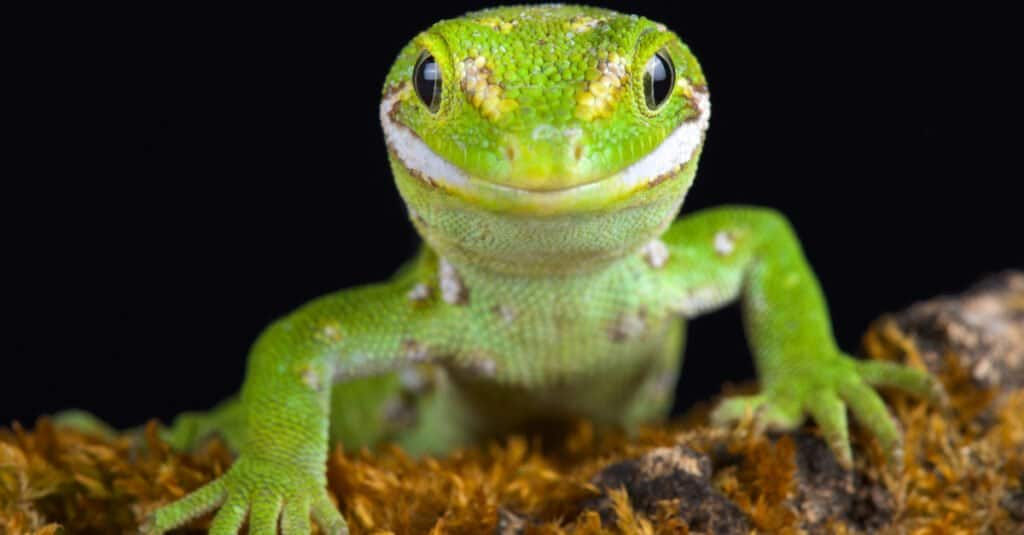
The major color is dark jade to lime green, with some animals show a even turquoise green. The skin between the scales is completely black. It forms 6-8 crossways bands across the back. With animals which are missing these ribbons little black rings may be seen. This form was described by MERTENS (1950) as V. p. kordensis and distinguished from the type race which shows the black crossways bands. A temporal stripe is not available. The coloration of the underside is prasinusuniformly light green, the throat is yellowish, sometimes with gray crossways bands. The nostril is in the middle between the tip of the snout and the eye. The head scales are large, the belly scales are slightly keeled. On the soles of the feet black scales are situated. 80-112 scale rows are around midbody. The tail is prehensile and round in the cross section. Its length is 2.0-2.7 times as long as the SVL. The total length is up to 70 cm. The food consists of insects, e.g. catydits, beetles and occasionally also in eggs and fledglings, which they can overpower in the nests (SPRACKLAND 1982b, 1989a, 1992a, GREENE 1986, LOSOS & GREENE 1988).
SPRACKLAND (1991b) eliminated the supspecies V. p. kordensis, because he mentioned, that all the taxonomic relevant characteristics are in the bandwidth of the characteristics of V. prasinus. He also mentioned, that both subspecies occur on mainland New-Guinea without any reports that both taxa occur sampatric.
ZIEGLER & BÖHME (1997) and also JACOBS (2001) mentioned, that V. p. kordensis is a valid taxa, because of the different morphological characteristics and a different structure of the hemipenis. It could be possible, that V. p. kordensis should be raised into species rank, but there must be further studies to validate this.

Distribution, habitat and behavior

prasinus

The distribution of this species with its subspecies extends on the whole island of New Guinea. V. p. prasinus is also found on some islands which in former times built a land bridge between New Guinea and Australia. The southernmost distribution, where this species was observed, is Moa Island (WHITTIER & MOELLER 1993, WILSON 1996). They live in the canopy of the still available jungle giants of the lowland forests up to a hight of 500 m above sea level. In the mountain regions they are missing (DEJONG 1927, MERTENS 1950, CZECHURA 1980, GREENE 1986, SPRACKLAND 1991b). The Green Tree Monitors are well adapted to the living to this particular habitat, because of the existence of a prehensile tail, an unusual feature in the monitor family. They use this possibility to safe itself on the branches of the trees, when they go on search for food. You can observe this behavior also occasionally in the enclosure.


Keeping and breeding
Because V. prasinus is a tree cimber, we offer the animals an enclosure, which must show a sufficient height. It might be necessary to build the enclosure so that you can separate the animals when required. Cork bark cover the side and the rear walls to make it possible for the animals, to use these vertical areas too. Occasionally they sleep even hanging at those walls. As substrate we use wood chips, which will be kept always a bit moist to increase the atmospheric humidity in the enclosure. Some branches offer the animals further climbing possibilities. A natural nesting box serves the monitors as shelter and as egg-laying possibility. It is filled also with damp wood chips.
Even if V. prasinus may be found within rain forest, they also need sufficient daylight exposure. It is best to install mercury preassure lamps to induce day light and a spot lamp, which should point onto a branch, to give the animals the possibility to heat up.
The captive husbandry of these beautiful monitor species is already reported a few times. The paper from CARLZEN (1982) differs from my experiences and other reports. These data might result on a temperature and/or incubation period measuring error.
prasinusA very detailed report was published by DEDLMAR (1994). He housed two groups for his 2.3 adults in which he replaced the two males occasionally. After the mating he took the male out off the enclosure so that the remaining female could drop the eggs without bein stressed. She deposited them in a nesting box filled with damp peat moss. The eggs were dug out and were incubated in damp vermiculite. At temperatures between 27-29°C the hatchlings opened the eggs after 185-190 days. The babies had a total length of 22 cm and a body mass of 11 g. The rearing of the babies together in one enclosure was without any complications. As food for the adult monitors he offered locusts, crickets, and mice. The youngsters were fed with maggots of the wax moth and house cricket.
BIEBL (1993) makes some statements to the incubation of the eggs of the Green Tree Monitor in her report. She housed one pair together in one enclosure. The female laid 8 eggs in November 1991. Three young animals hatched out at incubation temperatures between 26 and 30°C in damp peat moss-sand mixture after 205, 206 and 215 days. The monitors had an average total length of 135 mm at hatching.
Own experiences at the raising of babies of this monitor species have shown that the young animals hatched out after an incubation period of 202 to 206 days. The incubation in perlite was at temperatures between 27 and 29.5°C (EIDENMÜLLER 1998). The young animals had a SVL between 80 and 87 mm and a total length between 196 and 218 mm. The body mass was between 6.7 and 8.2 g. I offered the offspring small crickets as first food. They accepted even small beef heart pieces after some time. Any food was dusted with Korvimin ZVT® before feeding. The monitors grow well with this diet.
   
back